Gerador de Character Sheet
1 passos · cada card mostra o resultado e os botões pra copiar o prompt
Usar no Higgsfield (Canvas)
1. Clique no botão · 2. Abra higgsfield.ai/canvas e crie um canvas novo · 3. Clique no fundo do canvas e aperte Ctrl+V (no Mac, Cmd+V). O workflow inteiro entra na sua conta, já com as conexões. Depois troque as imagens de exemplo pelas suas.
01imagemNano Banana Pro16:92k
Create a **professional photorealistic character reference sheet** using ALL supplied reference images as source material.
## REFERENCE ANALYSIS — CRITICAL
Before generating the image, analyze the uploaded references and automatically determine what information each image provides.
Extract and preserve, whenever visible:
* facial identity
* facial proportions
* eyes
* eyebrows
* nose
* lips
* jawline
* cheekbones
* skin tone
* skin texture
* age appearance
* hairstyle
* hair color
* hair length
* body proportions
* height impression
* shoulder width
* torso proportions
* waist
* hips
* arms
* legs
* overall physique
* wardrobe
* shoes
* accessories
* jewelry
The **same person must appear in every panel**.
Do NOT average the character into a generic person.
Do NOT beautify, reinterpret, redesign or change the person's recognizable identity.
---
## REFERENCE PRIORITY LOGIC
Treat the supplied images intelligently according to what they actually show.
### CHARACTER / IDENTITY REFERENCES
Any image showing the person's face or body must be used to establish the character's identity.
Use multiple images together to reconstruct the most accurate and consistent representation possible.
If some references only show the face, use them for facial identity.
If some references show the full body, use them to determine body shape and proportions.
Never copy camera distortion, pose distortion or perspective distortion from an individual reference.
Instead, infer the person's real consistent appearance across all references.
### WARDROBE REFERENCES
If dedicated clothing, outfit, footwear or accessory references are supplied, treat them as **strict wardrobe references**.
Reproduce the referenced clothing as accurately as possible, including:
* garment type
* cut
* fit
* length
* silhouette
* material
* texture
* colors
* patterns
* seams
* accessories
* footwear
Apply the same wardrobe consistently to every full-body view.
If the clothing reference contains another model, IGNORE that person's:
* face
* body
* skin
* hair
* pose
* identity
Use ONLY the clothing and accessories from that image.
The character's identity and body must always come from the CHARACTER REFERENCES.
### IF NO DEDICATED WARDROBE REFERENCE EXISTS
Prioritize the references only for:
* identity
* face
* hair
* skin
* body shape
* body proportions
If there is one clearly consistent outfit visible across the character references, preserve that outfit.
If wardrobe information is incomplete, contradictory or unavailable, use a **simple neutral fitted outfit suitable for a professional character sheet**, without introducing elaborate fashion elements that were not requested.
Never allow uncertain wardrobe information to alter the person's body or identity.
---
# CHARACTER CONSISTENCY
This is ONE SINGLE CHARACTER photographed from multiple standardized angles.
The following must remain identical across EVERY panel:
* identity
* facial anatomy
* skin tone
* age
* hairstyle
* hairline
* hair color
* body proportions
* body shape
* clothing
* shoes
* accessories
No panel may look like a different person.
No facial drift.
No body drift.
No hairstyle drift.
No wardrobe drift.
No random changes between angles.
---
# EXACT CHARACTER SHEET LAYOUT
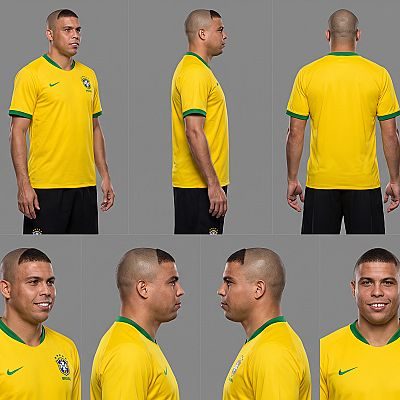
Create one large rectangular character sheet divided into **TWO HORIZONTAL ROWS**.
The composition should closely follow a professional VFX / 3D character turnaround reference sheet.
## TOP ROW — 5 FULL-BODY VIEWS
Create exactly FIVE evenly spaced full-body panels.
The entire character must be visible from head to footwear in every panel.
Maintain approximately the same character scale, camera height and framing across all five panels.
From LEFT to RIGHT:
### PANEL 1
Straight FRONT VIEW.
Character facing directly toward camera.
Neutral standing pose.
Arms relaxed naturally beside the body.
### PANEL 2
FRONT THREE-QUARTER VIEW.
Approximately 30–45 degrees rotation.
Full body visible.
### PANEL 3
STRICT SIDE PROFILE.
Approximately 90-degree side view.
Full body visible from head to feet.
### PANEL 4
STRAIGHT BACK VIEW.
Character facing completely away from camera.
Clearly show:
* back of hairstyle
* back of clothing
* shoulder shape
* waist
* hips
* legs
* footwear
### PANEL 5
OPPOSITE THREE-QUARTER VIEW.
Approximately 30–45 degrees from the opposite side.
Full body visible.
---
# BOTTOM ROW — 6 HEAD / UPPER-BODY REFERENCES
Create exactly SIX close-up portrait panels.
Frame approximately from upper chest / shoulders upward.
The face must remain extremely consistent across every angle.
From LEFT to RIGHT:
### PANEL 6
Straight frontal portrait.
### PANEL 7
Front three-quarter portrait.
### PANEL 8
Strict side-profile portrait.
### PANEL 9
Opposite side-profile portrait.
### PANEL 10
Straight frontal portrait.
Use this additional frontal reference to clearly reinforce facial identity and symmetry.
### PANEL 11
Opposite three-quarter portrait.
---
# POSE
Use a neutral character-reference pose.
No fashion posing.
No exaggerated hip movement.
No dramatic gestures.
No crossed arms.
No hands hiding important body areas.
No action pose.
No exaggerated facial expression.
The goal is to make the character easy to understand and reconstruct for:
* AI generation
* VFX
* CGI
* 3D modeling
* animation
* future character-consistency workflows
---
# FACIAL EXPRESSION
Use a neutral relaxed expression.
Eyes naturally open.
Mouth closed.
No smile unless the references strongly establish one as part of the character's normal appearance.
Preserve all distinctive facial characteristics.
Do not make the character more conventionally attractive.
Do not change facial symmetry unnecessarily.
---
# CAMERA
Professional character-reference photography.
Use a natural portrait perspective with minimal lens distortion.
Avoid:
* ultra-wide lens distortion
* fisheye
* exaggerated perspective
* dramatic depth of field
* cinematic camera angles
Full-body panels should look like they were photographed using the SAME camera and lens.
Portrait panels should also maintain consistent lens characteristics.
---
# LIGHTING
Clean neutral studio lighting.
Soft large frontal illumination with subtle fill.
Enough light to clearly reveal:
* facial structure
* skin
* hair
* clothing texture
* body silhouette
No dramatic lighting.
No colored lighting.
No rim-light effects.
No strong directional shadows.
No cinematic grading.
---
# BACKGROUND
Use the SAME seamless neutral light-gray studio background across the entire character sheet.
Clean matte gray.
Subtle natural contact shadows underneath the character in the full-body panels.
No scenery.
No furniture.
No props unless they are explicitly part of the character references.
No text.
No labels.
No logos added by the generator.
No decorative graphics.
---
# IMAGE QUALITY
Ultra-detailed photorealistic photography.
Realistic skin texture.
Natural pores and subtle skin variation.
Detailed realistic hair strands.
Accurate fabric texture.
Accurate clothing materials.
Realistic footwear.
Correct human anatomy.
Realistic hands and fingers.
High-resolution character reference photography.
Consistent exposure and white balance across every panel.
---
# ABSOLUTE CONSISTENCY RULE
Imagine that ONE REAL PERSON entered a professional studio and was photographed eleven times within a few minutes without changing:
* clothes
* hairstyle
* makeup
* accessories
* body
* identity
Only the viewing angle and framing changed.
Every image must unquestionably depict the EXACT SAME PERSON.
---
# DO NOT
Do NOT create multiple different people.
Do NOT redesign the face.
Do NOT alter ethnicity or skin tone.
Do NOT modify age appearance.
Do NOT change body proportions between panels.
Do NOT make the body thinner or heavier unless supported by references.
Do NOT enlarge or reduce body features arbitrarily.
Do NOT change hairstyle between panels.
Do NOT change hair length.
Do NOT change wardrobe between panels.
Do NOT create random accessories.
Do NOT crop heads.
Do NOT crop feet in full-body views.
Do NOT omit shoes.
Do NOT add additional characters.
Do NOT use dynamic poses.
Do NOT create a collage with random image sizes.
Do NOT create cinematic scenes.
Do NOT add captions or angle labels.
Do NOT add text.
The final result must look like a **single professionally photographed, highly consistent production-ready character sheet**, faithfully reconstructed from the supplied reference images.